
- Home
- Live Blog
- Breaking News
- Top Headlines
- Cities
- NE News
- Sentinel Media
- Sports
- Education
- Jobs
Staff Reporter
GUWAHATI: If everything goes as planned, the laying of underground cables for electricity will be a reality soon in certain areas of Guwahati city. The APDCL (Assam Power Distribution Company Ltd) has already submitted its DPR (detailed project report) to the concerned authorities of the Government of India to this effect.
A Rs 500-crore DPR covering the entire Guwahati City was prepared earlier. However, the project has faced delays due to various reasons. Of late, APDCL has moved forward with an underground electric cable-laying project covering a few areas of Guwahati – (i) Paltan Bazar Square involving a loop of AT Road, MD Shah Road and a portion of GS Road; (ii) AT Road from Paltan Bazar to Bharalumukh; (iii) GS Road from Paltan Bazar to GMCH Road; and (iv) MG Road from Bharalumukh to Padum Pukhuri to the juncture of MN Road and SS Road – at a cost of Rs 200 crore.
These areas of Guwahati are important from the standpoint of traffic intensity, commercial importance, public visibility, urban congestion, and the criticality of the distribution network.
As the procedure goes, state governments have to submit their DPRs for such projects to Power Finance Corporation Ltd (PFCL), which scrutinises the DPRs and forwards them to the Ministry of Power for final approval.
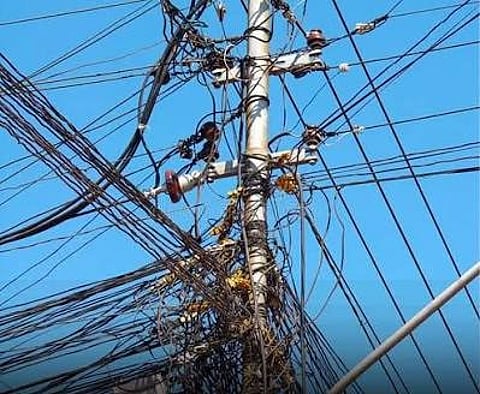
The electricity wires hanging overhead are fraught with the risk of electrocution. Uprooting or damaging electric poles during storms and heavy downpours leads to power supply disruption, besides risking lives. Underground electric wire will do away with the problem of tangled wire and poles that look like an eyesore. Apart from lessening the risk factor, underground electric lines also will reduce the T&D (transmission and distribution) losses of power to a large extent.
Low-lying areas that remain under water during the monsoon are no problems in this mode of electrification, as the electric wire will run within waterproof cables and pipes two or three feet beneath the ground.
Also Read: GUWAHATI: Man arrested with stolen electric wires in Basistha
