
- Home
- Live Blog
- Breaking News
- Top Headlines
- Cities
- NE News
- Sentinel Media
- Sports
- Education
- Jobs
The 8 year old Kiran and his dad stopped at a NH 16 highway restaurant and walked into a nearby toy counter. It had wooden trains, painted dolls and several handcrafted decorative items. Excited by the vibrant colours, Kiran pleaded with his father to buy him a wooden elephant.
Then a traveller standing next to his dad, asked where the products came from. “From a small factory nearby! Children are very good with this delicate work. Their fingers are fast and the products cost less.” For a brief moment, silence fell over the counter. Kiran’s father slowly put the toy back on the shelf and quietly asked his son, “would you still enjoy this toy if another child had to lose his school and childhood to make it?” Kiran looked puzzled for a moment and then declined to have the toy.
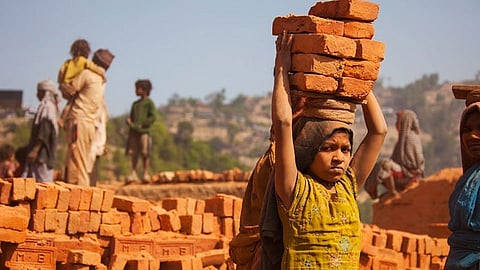
Today, we observe the International Day against Child Labour (June 12th). It is pertinent that we ask why child labour still persists in our own streets, villages and cities. According to the Census in 2011, India had over 10 million children engaged in labour between the ages of 5 and 14, though activists believe hidden and informal child labour remains significantly underreported.
India has certainly come a long way. However, a nation’s greatness cannot be measured merely by the height of its skyscrapers, the speed of its highways, or the sophistication of its technology.
True development is reflected in the dignity with which it treats its most vulnerable citizens, especially its children. India’s aspiration to become a global economic superpower loses its moral strength when millions of children are out-of-school.
Over the past three decades, India’s child protection laws have significantly contributed to reducing child labour. The Juvenile Justice Acts of 2000 and 2015 and their subsequent amendments have expanded the category of children in need of care and protection to include working children, while institutionalising rescue and rehabilitation systems through CWCs, JJBs, SJPUs and DCPUs.
The Right to Education Act, 2009 increased school enrolment and reduced the number of out-of-school children. Similarly, amendments to the Child and Adolescent Labour (Prohibition and Regulation) Act expanded prohibitions on hazardous and exploitative labour, particularly in the domestic and hospitality sectors. Therefore, while poverty is not the only factor sustaining child labour, the legal provisions over the decades have also contributed to reducing it to a certain extent. Yet, child labour continues to remain visible around us. They are found in domestic work, online gig-related packaging, home-based manufacturing, waste picking, street vending, agriculture and family businesses. At the heart of the problem lies deeply normalised social misconceptions.
One dangerous myth is, “Child Labour is inevitable in a developing country!” However, stronger public education systems, community vigilance, literacy movements, and social welfare measures in States like Keralam have managed comparatively lower levels of child labour. “Girls helping at home isn’t child labour” is an alarming justification. In many rural households in Rajasthan and Bihar, adolescent girls wake up before dawn to fetch water, cook meals, care for siblings, clean homes, and assist in agricultural work before or instead of attending school.
The consequences are severe: exhaustion, irregular attendance, early dropout and eventually child marriage. “Buying cheap goods has no moral consequence” is another commonly accepted excuse. India’s Sivakasi, carpet industries in Rajasthan and Uttar Pradesh, bangle making, and garments manufacturing units have been under public outrage. They employ children. Whenever society prioritises cheap labour over human dignity, children become the invisible price paid for economic convenience.
“Poor children must work to support their families” is a widely accepted belief. A 12-year-old working in a kiln may support the family temporarily, but the absence of education traps the next generation in the same cycle of debt, migration and exploitation. Unless India begins to see every child regardless of caste, creed, religion or income, as an equal citizen with equal rights, the battle against child labour remains incomplete.
Another deep-rooted perception is, “if children are with their families, it is not child labour”. In many poor households, ‘helping the family’ gradually turns into full-time labour, leaving little time for school education.
“Education is useless for poor children” is another damaging social assumption. This perception grows stronger when schools suffer from poor infrastructure and teacher shortages.
Weak educational systems indirectly strengthen child labour. Several rescued children eventually return to labour because rehabilitation systems remain weak without counseling, counseling, bridge schooling, family income support, hostel facilities, vocational pathways, and long-term educational tracking.
And lastly, "The Bhonti culture is often defended as tradition rather than recognised as exploitation!” Minor girls from Assam’s tea garden communities, Bodo tribes, tribes, and rural communities are sent to Arunachal Pradesh as domestic workers who are locally known as 'bhontis.' 'bhontis.' Several reported cases have involved confinement, physical abuse, and sexual exploitation.
These misconceptions must be countered by transforming public attitudes through a national social campaign, by making schools attractive, safe and meaningful, extending the spirit of the right to education up to the age of 18; giving economic support to vulnerable families; creating zero-tolerance zones against child labour; treating child labour as a national emergency; creating community responsibility where every citizen must act; ensuring rehabilitation follows rescue operations and finally building a moral vision of true development for the country. While the legal provision must continue to be strengthened, the misconceptions must be faced head-on.
If India truly wishes to become a global leader, it must ensure that no child is forced to exchange education for survival. Economic growth loses its moral legitimacy when childhood itself becomes a commodity. The true measure of a nation is not the wealth it creates but the childhoods it protects.
