
- Home
- Live Blog
- Breaking News
- Top Headlines
- Cities
- NE News
- Sentinel Media
- Sports
- Education
- Jobs
STAFF REPORTER
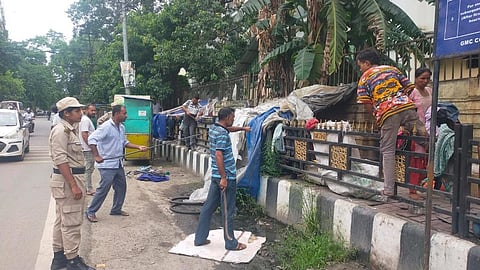
GUWAHATI: Repeated eviction drives by the Guwahati Municipal Corporation (GMC) have failed to prevent vendors and commercial establishments from reoccupying cleared public spaces, raising questions about the effectiveness of its enforcement mechanism.
At Ganeshguri, a food outlet reportedly resumed operations beside a public toilet despite an earlier closure action. Vegetable vendors also returned to roadside spaces in the locality after an eviction drive in October. Similarly, a roadside market resumed operations at Sijubari following an eviction drive in August.
The recurring encroachments have also caused resentment among street vendors, particularly those operating in areas such as Sixmile. Vendors alleged that authorities repeatedly removed their stalls without providing suitable alternative vending spaces.
"What are we supposed to do if we are not allowed to earn our livelihood? The authorities come, remove our stalls and leave. After a few days, the situation becomes the same again. If the government wants us to move, it should first provide us with a proper place to conduct our business. Eviction cannot be the only solution," a vendor at Six Mile said.
Residents have also questioned the GMC's failure to keep cleared spaces free from encroachment. In Beltola, residents expressed dissatisfaction over the repeated return of unauthorised occupation despite complaints and official interventions.
"What is the purpose of conducting eviction drives if the same spaces are occupied again after a few days? GMC officials come, clear the area and leave, but there is no follow-up. Are these drives only meant to create a temporary impression of action? The corporation must explain why it cannot keep the roads and footpaths clear after removing the encroachments," a Beltola resident said.
While eviction drives provided temporary relief to commuters and pedestrians, the lack of regular monitoring allowed encroachments to return. Designated vending zones also failed to offer a comprehensive alternative for street vendors across the city.
The recurring problem highlighted the need for sustained surveillance, accountability and a practical vending policy to prevent public spaces from being occupied again after eviction operations.
