
- Home
- Live Blog
- Breaking News
- Top Headlines
- Cities
- NE News
- Sentinel Media
- Sports
- Education
- Jobs
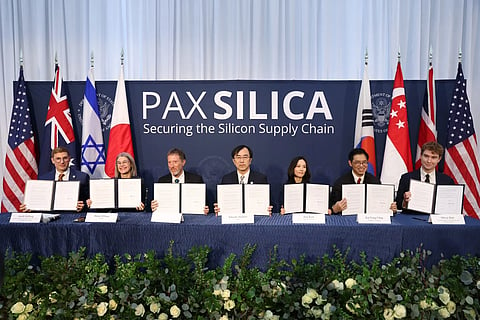
WASHINGTON: The US-led PaxSilica alliance has expanded to 24 member countries, with 35 nations endorsing a joint statement on artificial intelligence, as the Trump administration steps up efforts to build an international coalition around AI, advanced manufacturing and economic security.
Under Secretary of State for Economic Affairs Jacob Helberg said the initiative would continue to grow while focusing on practical projects and cooperation among member countries.
“Today, we’re at 24 and 35 countries that have signed the joint statement on AI opportunity,” Helberg told IANS.
“And we will continue to expand this coalition in a way that we think makes sense for the group in a way that we think promotes the goals that we’re trying to achieve, which is achieving, you know, sensible approaches to broad policy conversations and promoting tangible outcomes.”
Helberg said PaxSilica was designed as a flexible partnership in which participating countries could help shape its priorities.
“One of the benefits of PAX is that it is, it remains very flexible, and it really is meant to be a two-way street between ourselves as well as all of our members,” he said.
He said the initiative would pursue two parallel tracks — delivering concrete projects while encouraging broader discussions on technology policy and economic security.
“We want tangible projects,” Helberg said, citing “PAX Pass,” a $50 million foreign assistance package for Panama to roll out an AI logistics platform, the launch of “Foundry School” in partnership with Stanford University to develop an advanced manufacturing curriculum, and an economic security zone in the Philippines aimed at accelerating industrial investment.
Helberg said the administration viewed artificial intelligence as a driver of economic opportunity rather than a technology to be constrained. (IANS)
Also Read: Europe Unveils AI-Powered Next-Generation Battle Tank as India Advances FRCV Programme
