
- Home
- Live Blog
- Breaking News
- Top Headlines
- Cities
- NE News
- Sentinel Media
- Sports
- Education
- Jobs
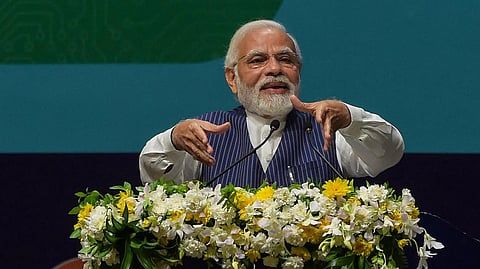
NEW DELHI: The India AI Impact Summit 2026 has kicked off in New Delhi, marking the first time a global AI summit is being hosted in the Global South. Prime Minister Narendra Modi shared his vision for AI in an interview, emphasizing the guiding motto of the Summit: "Sarvajan Hitay, Sarvajan Sukhaye" (Welfare for all, happiness of all). The summit aims to address AI's role in fostering inclusive growth, strengthening public systems, and enabling sustainable development.
PM Modi highlighted that AI is at a civilizational inflection point. It has the potential to expand human capabilities but could also disrupt social systems if not managed well. The summit's focus on equitable outcomes aligns with India's philosophy that technology should serve humanity, not replace it. India, by hosting the first global AI summit in the Global South, offers a platform that emphasizes under-represented voices and development priorities.
On Viksit Bharat 2047, Modi sees AI as a transformative tool to address development challenges and create new economic opportunities. AI is already improving healthcare by aiding early detection of diseases like tuberculosis and diabetic retinopathy at primary healthcare centers. It is also enhancing education, with AI-powered platforms providing personalized learning in regional languages. Additionally, initiatives like Amul's AI project help 36 lakh women dairy farmers in rural areas, offering real-time guidance in Gujarati.
Regarding AI bias, Modi reiterated the challenges of AI systems unintentionally perpetuating biases, particularly in diverse nations like India. AI trained primarily on urban or English data may not work effectively for rural users or those speaking regional languages. The AI Impact Summit 2026 aims to bring global attention to this issue and foster cooperation to address biases.
India's success in building low-cost Digital Public Infrastructure (DPI) such as Aadhaar and UPI has been instrumental in driving development. Modi emphasized the importance of converging DPI and AI for inclusive development. India's approach to building open, interoperable systems has ensured that digital services are accessible to all citizens, regardless of their socio-economic status or literacy levels. Modi sees this model as scalable and beneficial for the Global South.
India's IT sector remains a global powerhouse, contributing significantly to service exports. AI presents both opportunities and challenges for the sector. While AI doesn't replace the IT industry, it is transforming it, driving new waves of AI-enabled outsourcing and automation. Through the IndiaAI Mission, the government is focused on providing affordable access to world-class AI infrastructure to boost innovation and enterprise growth.
As for AI safety, Modi stressed the need for human oversight and safety-by-design to mitigate the risks of AI misuse. He proposed a global compact on AI governance to ensure transparency and to prevent its use in harmful applications like deepfakes or criminal activities.
Modi acknowledged concerns among youth about AI potentially replacing jobs. The government has launched a massive skilling initiative to prepare the workforce for an AI-driven future. AI, he argued, will enhance productivity in fields like healthcare, education, and law, creating new opportunities rather than reducing them.
Modi reaffirmed India's Aatmanirbhar Bharat vision. He envisions India as a leader in AI creation, not just consumption. The goal is for India to be among the top three AI superpowers globally, with AI models deployed worldwide in local languages. Through the IndiaAI Mission, the country is ensuring that its AI models reflect its values and are aligned with its vision of responsible global leadership in AI.
India is positioning itself as a hub for AI innovation, focusing on inclusive growth, global collaboration, and AI governance, with an emphasis on empowering people at the grassroots level. (ANI)
Also Read: India’s progress in AI will contribute to global advancement: PM Narendra Modi
