
- Home
- Live Blog
- Breaking News
- Top Headlines
- Cities
- NE News
- Sentinel Media
- Sports
- Education
- Jobs
A CORRESPONDENT
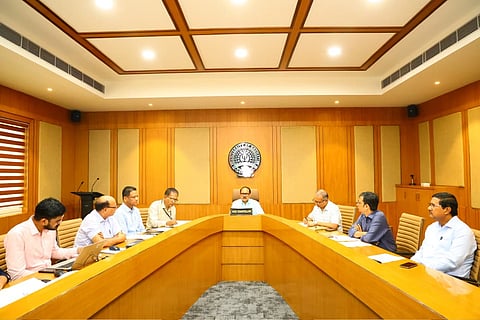
AZARA: Gauhati University’s Centre for Brahmaputra Studies (CBS) on Friday organised a one-day consultative workshop to review the draft Assam State Water Resources Assessment (SWRA) Report, a key document expected to guide the formulation of the upcoming Assam State Water Policy.
Held at the Vice-Chancellor’s Conference Room, the workshop brought together senior university officials, academicians from various departments, and experts from the Flood and River Erosion Management Agency of Assam (FREMAA) to discuss the report’s findings and offer recommendations before its finalisation.
In his inaugural address, Gauhati University Vice-Chancellor Prof Nani Gopal Mahanta highlighted the significance of the initiative, describing the Brahmaputra as the lifeline of the region and emphasising the university’s commitment to evidence-based research for sustainable water governance.
A team from FREMAA, led by Dr Pratap Singh, presented the report’s scope, methodology, and major findings. Prepared under the World Bank-funded Assam Integrated River Basin Management Programme (AIRBMP), the report provides a comprehensive assessment of the State’s water resources through the framework of Integrated Water Resources Management (IWRM).
The report examines five major themes—water resources, flooding and erosion, economic use of water, cultural and livelihood dependence on river systems, and water and environment.
The interactive session, moderated by Prof Dhrubajyoti Sahariah, Director of the Centre for Brahmaputra Studies, saw participants deliberate on several key issues, including the need for an effective transboundary hydrological data-sharing mechanism with neighbouring countries, improved flood management through non-structural measures, enhanced protection for erosion-affected char communities, restoration of wetlands and floodplain connectivity, expansion of irrigation coverage, and greater recognition of cultural and livelihood values in water resource planning.
Also Read: Khagen Bezbaruah: A lifelong custodian of Assam’s folk heritage
