
- Home
- Live Blog
- Breaking News
- Top Headlines
- Cities
- NE News
- Sentinel Media
- Sports
- Education
- Jobs
OUR CORRESPONDENT
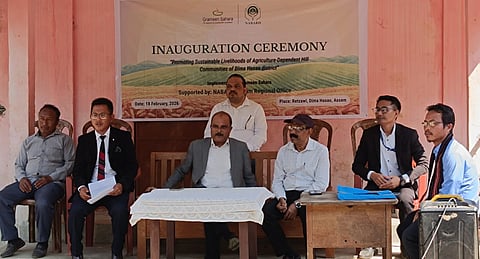
HAFLONG: Retzawl village in Harangajao Block of the Dima Hasao Autonomous Council (DHAC) witnessed a significant milestone on Wednesday with the formal launch of the NABARD-supported FSPF Project titled “Promoting Sustainable Livelihoods of Agriculture-Dependent Hill Communities of Dima Hasao District” and the inauguration of The Habitats Trust (THT) Programme. The event, organized by Grameen Sahara, brought together distinguished guests, community leaders, and stakeholders. Loken Das, Chief General Manager of NABARD Assam Regional Office, Guwahati, graced the occasion as Chief Guest and formally launched the FSPF Project as well as inaugurated the THT Programme.
Supported by NABARD, this two-year project will empower 100 small and marginal farmer households—especially women—in Retzawl village. It focuses on strengthening Self-Help Groups (SHGs), promoting climate-smart agriculture, improving natural resource management, and enhancing income diversification. The project introduces crop diversification, climate-resilient farming practices, improved livestock management, and water resource conservation. Capacity building, business skills training, value chain development, and market linkages will bolster women-led SHGs for long-term sustainability.
Dima Hasao faces multiple environmental and socio-economic challenges. Despite nearly 70% forest cover, DHAC is highly vulnerable to climate change, with erratic rainfall, prolonged dry spells, rising temperatures, and landslides disrupting traditional jhum cycles. Soil degradation, drying springs, and declining productivity have deepened rural poverty, while limited infrastructure, market access, and employment opportunities restrict livelihood options. The FSPF project aims to build adaptive capacity, enhance farm productivity, secure sustainable incomes, and promote community-level natural resource management.
The Habitats Trust-supported programme will strengthen governance and sustainable management of nearly 10,000 hectares of Community Conserved Areas (CCAs) across ten landscapes in DHAC. These forests, traditionally managed by indigenous communities such as Biate, Dimasa, Hmar, Khasi-Pnar, Kuki, and Zeme tribes, are vital for biodiversity conservation, water security, and carbon sequestration. However, forest fragmentation, weakening of traditional institutions, unsustainable jhum practices, and limited ecological monitoring threaten these ecosystems. Climate vulnerability further exacerbates degradation, risking both biodiversity and livelihoods. The THT initiative will revitalize community-led conservation, restore degraded forest patches, enhance carbon sinks, and integrate conservation with climate-resilient livelihoods. By blending traditional knowledge with scientific tools, it envisions empowered community institutions governing resilient ecosystems.
Also Read: Guwahati: NABARD Holds Workshop on MPACS Development
