
- Home
- Live Blog
- Breaking News
- Top Headlines
- Cities
- NE News
- Sentinel Media
- Sports
- Education
- Jobs
OUR CORRESPONDENT
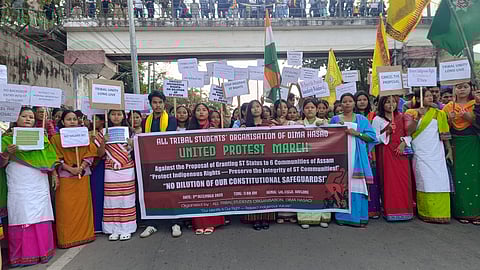
HAFLONG: Thousands of tribal students and community members under the banner of the All Tribal Students’ Organization of Dima Hasao took to the streets of Haflong on Wednesday in a powerful show of unity against the Assam Government’s proposal to grant Scheduled Tribe (ST) status to the six communities of Chutia, Koch-Rajbongshi, Matak, Moran, Tai-Ahom, and Tea Tribe (Adivasi).
The protest rally, one of the largest seen in the hill district in recent times, commenced from Lal Field, passed through major town areas including Sambudhan Statue and Council Rotary, and culminated at the office of the Deputy Commissioner, Haflong. Protesters carried banners and placards with strong messages such as ‘No Dilution of ST Safeguards,’ ‘Protect Indigenous Tribal Rights,’ ‘Our Identity is Not Negotiable,’ and ‘Reject ST (Valley) Category — Save Hill Tribes.’ Speakers at the rally warned that granting ST status to these six communities, even under the proposed new sub-category of ST (Valley), would severely undermine the constitutional protections and limited resources meant for existing Scheduled Tribes, particularly the hill tribes of Assam. Student leaders argued that the six communities collectively number over 80–90 lakh, far outnumbering the current ST population of Assam, which stands at approximately 38–40 lakh (around 12.4% of the state’s population). They fear that inclusion of these numerically stronger and relatively advanced communities would drastically reduce opportunities in education, government jobs, political reservations, and access to welfare schemes for the already recognized tribal groups.
Speaking to reporters, ADSU District Committee President Uttam Langthasa said, “This move will dilute the very purpose of ST reservation, which was created to uplift historically disadvantaged and marginalized indigenous tribes. These six communities are socially, educationally, and economically far ahead of the existing STs, especially the tribes in the hills. We will not allow our rights to be sacrificed for political gains.” Mairing Johori, President of the ADSU Central Committee, added, “Creating a separate ‘ST (Valley)’ category is nothing but a back-door entry. It will eventually lead to merging and sharing of quotas, leaving genuine tribal communities with crumbs.” Liengoujao Singson, General Secretary of the Kuki Students’ Organization (KSO) Assam, who also joined the protest, stated, “The combined population of these six communities is more than double the existing ST population. Once they enter the ST list, they will dominate every sphere, from Assembly seats to college admissions and government jobs. This is a direct assault on the survival and identity of smaller indigenous tribes.”
A memorandum was submitted to Durga Das Uikey, Union Minister of State for Tribal Affairs (through the Deputy Commissioner), urging the Government of India to reject the recommendations of the Group of Ministers and protect the sanctity of the existing Scheduled Tribes list in Assam. The protesters warned of intensified agitation across the hill districts and beyond if the Centre proceeds with the proposal. They also appealed to all recognized tribal communities of Assam, both hills and plains, to unite against what they called ‘a dangerous dilution of indigenous rights.’ The protest remained peaceful but resolute, reflecting growing anxiety among Assam’s existing Scheduled Tribes over the potential restructuring of one of India’s most sensitive constitutional safeguards.
Also Read: Assam: BJP slams opposition over ST status report for 6 communities