
- Home
- Live Blog
- Breaking News
- Top Headlines
- Cities
- NE News
- Sentinel Media
- Sports
- Education
- Jobs
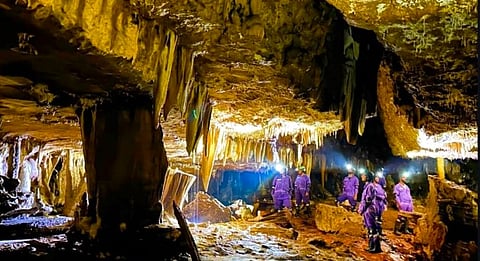
Meghalaya: Local communities in Meghalaya have introduced a strict daily visitor cap of 25 tourists at Mawmluh Cave near Sohra in November 2026, while enforcing zero-infrastructure caving rules to protect its ancient geological formations. The measures, managed by the Mawmluh Allied Activities Co-operative Society, respond to growing threats from climate change and limestone mining.
Mawmluh Cave, also known as Krem Mawmluh, is located near Sohra (Cherrapunji) in Meghalaya's East Khasi Hills district. Its newly enforced visitor restrictions reflect the local community's approach to protecting fragile underground geological formations.
Under the regulations introduced in November 2026, daily entry is restricted to 25 tourists. The community-managed system also prohibits infrastructure that could alter the cave's natural environment.
Milton Marak, a 27-year-old local cave guide, explained the conservation philosophy at the cave entrance.
"We’ve deliberately kept the cave natural."
The approach prioritizes preserving the cave's existing conditions rather than introducing artificial facilities for tourism.
Mawmluh Cave has particular scientific importance because it contains a stalagmite that serves as the official global geological marker for the Meghalayan Age. The geological marker dates back approximately 4,200 years. It identifies the beginning of the Meghalayan Age, a period associated with a severe mega-drought.
The International Union of Geological Sciences (IUGS) recognizes the geological significance of this marker. Mawmluh Cave is also associated with UNESCO's World Heritage Tentative List.
Stretching 7.2 kilometres, the cave is the fourth-longest cave in the Indian subcontinent. Its geological formations make conservation especially important.
Erratic monsoon downpours and decades of unregulated limestone mining across Meghalaya's plateau have increased pressure on fragile subterranean ecosystems.
These threats have encouraged local village bodies to adopt stricter conservation measures. At Mawmluh Cave, the daily visitor ceiling and zero-infrastructure rules form part of a low-impact ecotourism model.
The absence of electric lighting is another defining feature of the management approach. Rather than installing artificial illumination, the community has chosen to keep the cave's interior natural.
The Mawmluh Allied Activities Co-operative Society is the community-run body responsible for managing the cave's activities and visitor regulations.
Its approach places local community management at the centre of tourism and conservation. The 25-person daily limit provides a clear restriction on visitor access while protecting the cave's geological heritage.
For Milton Marak and other local guides, preserving the cave's natural condition remains central to how visitors experience the site.
The November 2026 restrictions establish a tightly controlled tourism model at one of Meghalaya's most important geological sites, with conservation taking priority over infrastructure expansion.
