
- Home
- Live Blog
- Breaking News
- Top Headlines
- Cities
- NE News
- Sentinel Media
- Sports
- Education
- Jobs
The Meghalaya government has moved to reassure the public that no permanent construction will be permitted on Lumpongdeng Island in Umiam Lake, even as environmental groups escalate their opposition to a proposed tourism project in the ecologically sensitive area.
Chief Minister Conrad Sangma on Thursday sought to address growing public concern, but his assurances have done little to calm protesters who are now demanding the project be cancelled outright.
Sangma stated that the agreement between the government and the tourism department explicitly prohibits any permanent structures on the island.
Only temporary arrangements — tents, pandals, and stalls — will be allowed, and only for short durations of around a week to ten days, after which they must be dismantled. The Chief Minister said the government has taken a position that goes beyond what environmental regulations strictly require, ruling out any long-term infrastructure on the island.
Also Read: Whose fault is it? Within one month, repaired NH-127B damaged
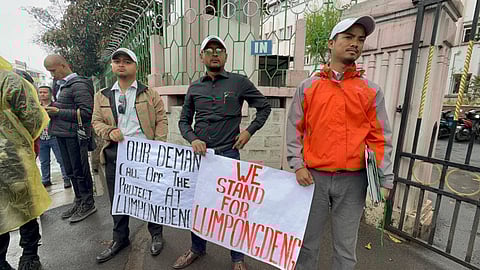
Members of the Green-Tech Foundation (GTF) have launched an indefinite hunger strike outside the State Secretariat, demanding the immediate and formal cancellation of the project.
The proposal involves the allocation of 36 acres of land on the island and has been linked to Tata Group's Indian Hotel Company Limited (IHCL). Activists allege that the project threatens the island's fragile ecosystem, which serves as a habitat for migratory birds and supports rich biodiversity.
Protesters have also raised questions about procedural irregularities, claiming that while IHCL's name is associated with the project, actual implementation is reportedly being handled by a different entity entirely.
The agitation has gathered momentum following earlier demonstrations at Lumpongdeng Island itself, with activists now bringing their campaign directly to the State Secretariat in Shillong.
GTF leaders have made their position clear — the hunger strike will continue indefinitely until the government formally withdraws the project, with no room for compromise on assurances alone.
The situation reflects a broader tension between tourism development ambitions and the push to protect ecologically sensitive areas in the Umiam Lake region.
With the government holding firm on its assurances and protesters holding firm on their demands, a resolution does not appear imminent.
