
- Home
- Live Blog
- Breaking News
- Top Headlines
- Cities
- NE News
- Sentinel Media
- Sports
- Education
- Jobs
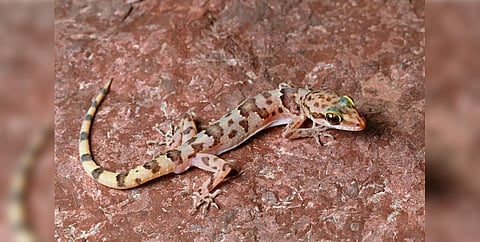
Shillong: Researchers have described two new cave-dwelling bent-toed gecko species, Cyrtodactylus bossmit and Cyrtodactylus kremicola, from limestone caves in Meghalaya, on Thursday, taking the state's recognized species count to nine. The findings were published in the international journal Taprobanica.
The two newly described species belong to the bent-toed gecko genus Cyrtodactylus. Researchers identified them from limestone cave habitats in Meghalaya's Khasi and Jaintia Hills.
The discovery was made by a research team comprising Cynthia M. Umlong, Manmath Bharali, Arup K. Hazarika, Holiness Warjri, Madhurima Das and Jayaditya Purkayastha, who served as the corresponding author and lead researcher.
The researchers are affiliated with Assam Don Bosco University, Cotton University and Guwahati-based biodiversity organisation Help Earth.
The findings were published in Taprobanica, Volume 15, Number 2, on November 25.
According to the study's abstract, molecular analyses identified multiple evolving lineages among gecko populations previously grouped under the name Cyrtodactylus khasiensis.
The researchers used molecular and morphological evidence to distinguish the two newly described species from previously recognised populations.
The study reports an uncorrected genetic distance, or p-distance, of 4%–7.6% from Cyrtodactylus khasiensis, based on analysis of the mitochondrial ND2 gene.
These findings helped establish the distinct identities of the two species rather than treating them as members of an already recognized group.
The study records a snout-to-vent length (SVL) of 81.7 mm for Cyrtodactylus bossmit and 83.6 mm for Cyrtodactylus kremicola.
The reported collection locations include Maw Tynghiang Cave, Wahlong Byrong and Rupasor Cave, all associated with the Khasi and Jaintia Hills region of Meghalaya.
The discoveries bring the recognized number of Cyrtodactylus species in Meghalaya to nine. Across Northeast India, the genus has nearly 31 recognized species, according to the supplied study details.
The study identifies the Khasi–Jaintia Hill complex as a centre of micro-endemism within the Indo-Burma biodiversity hotspot.
Micro-endemism refers to species having highly restricted geographic distributions. The researchers' findings point to multiple distinct evolutionary lineages among populations that were previously classified under one species name.
Historically, similar bent-toed gecko populations across Northeast India were grouped under Cyrtodactylus khasiensis, described by Thomas C. Jerdon in 1870.
Modern molecular analysis, combined with morphological examination, has enabled researchers to distinguish previously grouped populations and describe separate species.
The latest findings add two more recognized species to Meghalaya's reptile diversity and highlight the importance of studying its limestone cave habitats.
The complete research paper and its scientific findings are available through the journal's website at Taprobanica .
