
- Home
- Live Blog
- Breaking News
- Top Headlines
- Cities
- NE News
- Sentinel Media
- Sports
- Education
- Jobs
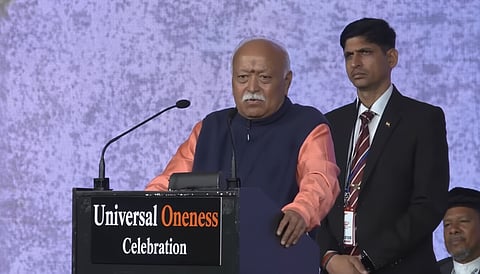
New York: RSS chief Mohan Bhagwat has said dharma should not be understood as religion or a form of worship, describing it instead as a universal principle that balances the needs of individuals, society and the environment.
Addressing the Universal Oneness Celebration at Madison Square Garden in New York, Bhagwat said the idea of dharma went beyond religious identity and ritual practice.
“Dharma is not religion. It is not a worship. It is beyond all this,” he said.
“It is the rule through which universe is sustained. It is the rule through which human beings can manage dualities of life.”
Bhagwat said dharma allowed different parts of life to progress together. It did not demand the sacrifice of individuals for society, or the weakening of society to enable individual success.
“It is not that societal progress will happen only when individuals are suppressed. No. It is not that society had to be suppressed to make individual successes. No,” he said.
“Individual society and the environment, they have to proceed together, progress together.”
Bhagwat extended the same principle to the human personality, saying physical, mental and intellectual development must move in balance. “Your body, your mind, intellect, they have to proceed together, progress together,” he said.
He described dharma as a middle path that connects different parts of existence without creating conflict among them. “This principle, which unites everything, which upholds everything, which doesn’t cause a rift, let not that happen, and which balances everything, which is a middle path, that is Dharma,” Bhagwat said.
Bhagwat has said India has a civilisational mission to help the world recognise unity amid diversity, arguing that Bharatiyas must convey this message through their conduct rather than preaching. He said both unity and diversity are embedded in Bharat’s DNA, reflecting the country’s long-standing civilisational ethos of embracing diversity while remaining united.
“Nations are not merely geographical entities,” Bhagwat said. “Every nation has a message to deliver. Every nation has a mission to accomplish. Every nation has a destiny to fulfil.”
India’s destiny was to recognise the unity underlying the world’s many differences and periodically remind humanity of that principle, he said.
“We are one and due to diversity that oneness is decorated. So diversity has to be celebrated, has to be respected, has to be accepted,” Bhagwat said.
“At the same time, we must keep in mind this feeling of oneness. It is a very real feeling.”
Bhagwat contrasted the language commonly associated with the United States and India. America, he said, was frequently discussed in terms of pluralism, while India was identified with unity in diversity.
“When we say America, United States of America, one word is often discussed frequently. That is pluralism. And when we say Bharat, another phrase is discussed, unity in diversity,” he said.
Bhagwat has pledged the organisation's full support to religious leaders working to promote interfaith cooperation, saying sustained grassroots action can change the global climate of conflict and mistrust.
"RSS with all its might is always with you because we are on the same page," Bhagwat told an international gathering of religious leaders in New York.
Addressing the "One World, One Humanity" programme, attended by more than 180 participants from 30 countries, Bhagwat said religious diversity should be respected and protected.
The RSS Chief also addressed questions surrounding the organisation's approach towards Muslims. Recalling an interaction with Muslim participants in Delhi in 2018, he said he had been asked whether Muslims would be driven out of India under the idea of a Hindu nation. "I said no. That is not Hindu," Bhagwat said. "If any Hindu thinks that there should be no Muslim in Bharat. He will not remain Hindu."
Bhagwat said dialogue with Muslim and Christian communities in India had continued since that 2018 meeting.
Dialogue and service, he added, must proceed together and begin within communities rather than through political intervention.
"These things do not happen through politics. Sorry to say, but the fact is, politics has now become a game of self-interest," he said.
"We and ours is the solution. So our experience in Bharat is that we have to start with the society."
Bhagwat said political policies could eventually be influenced by building a strong public consensus.
In a democracy, he said, politicians would find it difficult to disregard firmly established public opinion. (IANS)
Also Read: Assam: Four Killed, Seven Injured in NH-27 Accident at Khetri
