
- Home
- Live Blog
- Breaking News
- Top Headlines
- Cities
- NE News
- Sentinel Media
- Sports
- Education
- Jobs
Staff Reporter
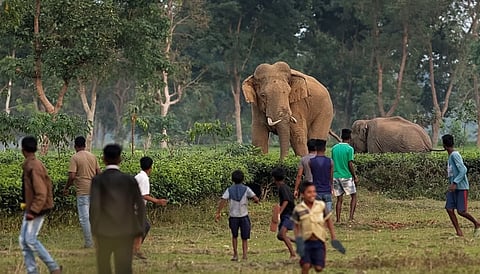
Guwahati: A discussion was held in the Assembly today on the issue of human-elephant conflict in the state. The government said that the matter is serious and that it is implementing both short-term and long-term measures to mitigate the conflict.
The discussion was initiated by BJP MLA Padma Hazarika in the House. He said that wild elephants are creating havoc in the foothills of Bhutan and adjoining areas in Assam. To tackle the problems, there is a need for a coordinated effort by all the stakeholders. It is also necessary to identify the root causes for the issue, he said.
BJP alliance partner BPF MLA Maheswar Boro also raised the issue in the House and urged the government to find ways to tackle it.
Forest Minister Jayanta Mallabaruah, in his reply, said that the government is equally serious and that the human-elephant conflict was earlier concentrated in a few districts, but it has now spread to many other districts. "The problem exists in places where forest areas are getting depleted. Elephants are also migrating into Assam from the neighbouring states of Meghalaya, Nagaland and Arunachal, as well as Bhutan."
He said that the forest department will hold discussions on July 15 with MLAs in whose areas the problem is more acute. After discussions with the MLAs, the department will consult wildlife experts on ways to mitigate the problem. "We have to reclaim the elephant habitats. Secondly, we have to create buffer zones so that the elephants do not venture into human habitations in search of food and water. We have to provide fodder for the elephants in the places they cross when coming to the human-populated areas. We should also dig ponds to store water for the elephants in these areas," he said.
"We have set up solar-powered electric fences, but they are not proving to be effective. So, we're planning to plant lemon trees, as they have prickly stems and thwart the elephants. We will also initiate a pilot project for beekeeping in areas frequented by elephants, as their presence is believed to disturb these animals. We've also expanded the Gaja Mitra scheme from 8 to 26 districts. Elephants destroy paddy fields, and farmers are forced to take action against them by various means. So, we will now pay a compensation of Rs 8,000 per bigha to farmers whose croplands are destroyed by elephants," the Forest Minister said.
According to a wildlife expert, elephants' habitats have been lost by 35% over the last four decades due to human settlement, deforestation, road and railway track construction, etc. The habitats have decreased, but the elephant population has increased. It is estimated that around 6,000 elephants live in Assam at present. Additionally, they also venture into Assam from neighbouring states.
"There are 12 elephant corridors in the state. But some corridors have been encroached upon; as a result, their natural movement has been impeded, and they venture into human habitations. Therefore, elephant corridors should be legally protected. This is important because it is highly unlikely that all of the corridors are linked to national parks or sanctuaries. Some of the corridors are also linked to neighbouring states, like D'Ering-Dibru Saikhowa, which lies in both Assam and Arunachal Pradesh. The Deosur corridor is linked with Kaziranga and East Karbi Anglong. The Depota elephant corridor is linked with Nameri National Park and Sonai-Rupai Wildlife Sanctuary. The Bogapani corridor connects Upper Dehing blocks and faces significant disruptions from National Highway 38 and the railway track. Chirang-Ripu and Sonitpur Reserves - this expansive area supports transboundary movement, linking Bhutan and Arunachal Pradesh. Moreover, the obstacles created in the elephant corridors near Numaligarh Refinery and the Amchang Wildlife Sanctuary have forced elephants to stray into human-habited areas," the expert explained.
Also Read: Jorabat Flash Flood Chaos Exposes NH 27 Vulnerability, Sparks Questions Over NHAI
