
- Home
- Live Blog
- Breaking News
- Top Headlines
- Cities
- NE News
- Sentinel Media
- Sports
- Education
- Jobs
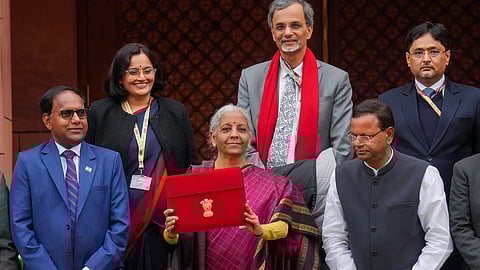
NEW DELHI: Union Finance Minister Nirmala Sitharaman announced several measures to boost manufacturing, a tax holiday for global data centres, and incentives for the agriculture and tourism sectors as she unveiled a Rs 53.5-lakh crore Union Budget 2026-27, on Sunday. The budget is a long-term blueprint for sustainable growth amid rising global risks. The fiscal deficit has been reduced to 4.3% from 4.4% in the current financial year.
The Finance Minister said that India’s economic trajectory has been marked by stability, fiscal discipline, sustained growth, and moderate inflation in the last 12 years. The government has continuously pursued far-reaching structural reforms, fiscal prudence, and monetary stability whilst maintaining a strong thrust on public investment. She said that keeping ‘self-reliance (Atamnirbharta) at the core, the government has built domestic manufacturing capacity and energy security and reduced critical import dependencies along with ensuring citizen-centric development and undertaking reforms to support employment generation, agricultural productivity, household purchasing power, and universal services to people. These measures have delivered a high growth rate of around 7% and helped us make substantial strides in poverty reduction and improvement in the lives of people, she said.
Presenting her record 9th straight budget, Sitharaman stepped up the government's capital expenditure outlay to Rs 12.2 lakh crore from Rs 11.2 lakh crore last year, underscoring its focus on infrastructure-led growth amid global uncertainty.
Nirmala Sitharaman said that in an external environment in which trade and multilateralism are imperilled and access to resources and supply chains is disrupted, new technologies are transforming production systems while sharply increasing demands on water, energy, and critical minerals; India will continue to take confident steps towards Viksit Bharat by balancing ambition with inclusion and must remain deeply integrated with global markets, exporting more and attracting stable long-term investment. The Finance Minister expressed gratitude to the people for standing firmly with the government and forging the way together towards becoming one of the largest economies in the world.
Highlighting the government’s aim to transform aspiration into achievement and potential into performance, the finance minister said that the government is ensuring that dividends of growth reach every farmer, the scheduled caste, the scheduled tribes, the nomads, the youth, the poor, and the women.
The Finance Minister said that the government has undertaken comprehensive economic reforms towards creating employment, boosting productivity, and accelerating growth. She said that after the Prime Minister’s announcement on Independence Day in 2025, over 350 reforms have been rolled out. These include GST simplification, notification of labour codes, and rationalisation of mandatory quality control orders. High-level committees have been formed, and in parallel, the Central Government is working with the State Governments on deregulation and reducing compliance requirements. She said that this Reform Express is well on its way and will maintain its momentum to fulfil the Kartavya.
Nirmala Sitharaman proposed interventions in six areas under the first Kartavya to accelerate and sustain economic growth: (i) scaling up manufacturing in 7 strategic and frontier sectors; (ii) rejuvenating legacy industrial sectors; (iii) creating “Champion MSMEs”; (iv) delivering a powerful push to infrastructure; (v) ensuring long-term energy security and stability; and (vi) developing city economic regions.
The Finance Minister said that the second Kartavya is to fulfil aspirations and build capacity. She said that close to 25 crore individuals have come out of multidimensional poverty through a decade of our government’s sustained and reform-orientated efforts. She highlighted that the government has decided to place a renewed emphasis on the services sector to provide a pathway to fulfilling aspirations of a youthful India, with measures like setting up a high-powered ‘Education to Employment and Enterprise’ standing committee to recommend measures that focus on the services sector as a core driver of Viksit Bharat. The Committee will prioritize areas to optimise the potential for growth, employment, and exports. They will also assess the impact of emerging technologies, including AI, on jobs and skill requirements and propose measures thereof. This will make India a global leader in services, with a 10% global share by 2047, she said.
Also, the tax on buybacks for all types of shareholders will be taxed as capital gains.
Other measures include TCS on the sale of overseas tour packages slashed to 2 per cent, while the same on overseas education and medical expenses under LRS (Liberalised Remittance Scheme) is cut to 2 per cent.
Sitharaman said the new Income Tax Act, 2025, will be implemented from April 1, with simpler rules and forms coming out soon.
The government, she said, has undertaken comprehensive economic reforms towards creating employment, boosting productivity and accelerating growth.
"Over 350 reforms have been rolled out." These include GST simplification, notification of labour codes, and rationalisation of mandatory quality control orders."
High-level committees have been formed, and in parallel, the central government is working with the state governments on deregulation and reducing compliance requirements.
For the infra push, a new Dedicated Freight Corridor will be set up connecting Dankuni in the East to Surat in the West. Besides, 20 new National Waterways (NW) will be operationalised over the next five years, a Coastal Cargo Promotion Scheme will be launched, and incentives will be provided to indigenise the manufacturing of seaplanes.
For clean energy, an outlay of Rs 20,000 crore over the next five years was announced for Carbon Capture Utilization and Storage (CCUS) technologies.
The government will develop seven high-speed rail corridors between cities as 'growth connectors' to promote environmentally sustainable passenger systems.
Tax measures include tax exemption on interest awarded by the Motor Accident Claims Tribunal to a natural person, rationalising of penalty and prosecution provisions, exemption from Minimum Alternate Tax (MAT) to all non-residents who pay tax on a presumptive basis, and the TCS rate for sellers of specific goods, namely liquor, scrap and minerals, will be rationalised to 2 per cent, and that on tendu leaves will be reduced from 5 per cent to 2 per cent.
The basic customs duty exemption given to capital goods used for manufacturing lithium-ion cells for batteries has been extended, as has been the same on the import of goods required for nuclear power projects. Duty-free personal import of drugs/medicines and food for 7 more rare diseases has been allowed.
To address practical issues of small taxpayers like students, young professionals, tech employees, and relocated NRIs, she proposed to introduce a one-time 6-month foreign asset disclosure scheme.
Christian de Guzman, Senior Vice President, Moody's Ratings, said in addition to the continued spending on infrastructure, the Budget provides tactical support for the economy against the backdrop of prevailing external uncertainties, including the unresolved issues around US tariffs, and despite the proven resilience of economic growth over the past year.
“At the same time, support for the economy, which includes measures announced in recent months such as GST rationalisation, will lead to an ongoing erosion of tax revenue as a share of GDP that will worsen debt affordability as measured by interest payments relative to revenue. Moreover, we do not expect significant progress on debt reduction, which supplants deficit consolidation as the anchor for fiscal policy, leaving our broader assessment of India's fiscal strength intact.” (PIB and other agencies)
Also Read; FM Sitharaman Announces Mahatma Gandhi Gram Swaraj Yojana, Bio Pharma Shakti
