
- Home
- Live Blog
- Breaking News
- Top Headlines
- Cities
- NE News
- Sentinel Media
- Sports
- Education
- Jobs
Staff Reporter
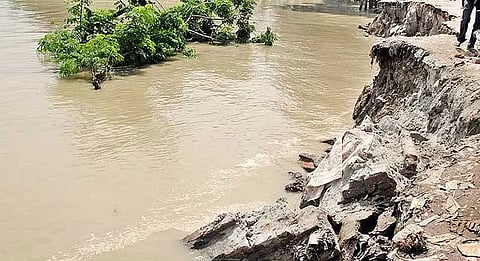
Guwahati: Along with the annual floods, erosion is a major threat in Assam. As more attention is given to floods, erosion is receiving less importance, and its threat has increased over the years. Erosion is not only associated with the Brahmaputra and Barak Rivers but also all major rivers in the state.
Official sources said they have identified around 200 erosion-prone areas across the state. Of these areas, anti-erosion measures have been taken only in limited areas. As a result, huge tracts of land on the riverbanks are eroded every year. Moreover, the steps taken to check erosion are not scientific in their approach, as a result of which the government has not been able to check the menace of erosion.
A retired engineer of the Water Resources Department told The Sentinel, "There are differences between the rivers in Assam and other parts of the country. Erosion is rare in other parts of the country but is rampant in Assam due to various reasons--the soil on the riverbanks in Assam is soft and is easily eroded when strong currents surge through the river and hectares of land are eroded in a very short span of time. Moreover, there is a high sediment load in Assam's rivers. Heavy monsoon discharge also plays a major role in erosion. The river channels are also braided. Erosion causes significant damage in Assam for these reasons and others.
According to departmental data, since 1950, an area of more than 4.7 lakh hectares of land has already been eroded by the Brahmaputra and its tributaries. This means that the average erosion of land is 8,000 hectares annually. Several reasons have led to the widening of the Brahmaputra, to an extent of 16 km in some places. According to a departmental survey, between 1912 and 1928, the area covered by the Brahmaputra was 3,870 square km. The next survey between 1963-75 found that the area increased to 4,850 square km and a survey in 2006 found it to be 6,080 square km.
Another study has found that almost 750 km of bankline on both sides of the Brahmaputra has a potential erosion tendency. Erosion tendency is considerably higher on the north bank line, whereas in the upstream areas of Guwahati, the erosion tendency is considerably higher on the south bank line. It urgently warrants attention for undertaking the river management planning of the Brahmaputra and a holistic approach.
Erosion is now taking place in a major way in rivers like Buridihing, Dikhow, Ranganadi, Kopili, Mora Pagladiya, Beki, Gangadhar, etc. Anti-erosion measures like geo-bags are being used in some places to check erosion, while the traditional porcupines are being used in others. Water Resources officials said, "Erosion is taking place in different areas every year. Due to the non-cohesive alluvial soil, it is easily eroded. It's almost impossible to check erosion in every erosion-prone area."
Chief Minister Dr Himanta Biswa Sarma recently said that the government is now giving more importance to the erosion problem, saying that scientific and long-term measures are needed to check the menace. He stressed that the government is working to fortify the riverbanks prone to erosion. He also stated that a discussion will soon take place with experts in IIT Guwahati to find lasting solutions to the issue.
