
- Home
- Live Blog
- Breaking News
- Top Headlines
- Cities
- NE News
- Sentinel Media
- Sports
- Education
- Jobs
Correspondent
Shillong: Union Minister for Finance and Corporate Affairs, Nirmala Sitharaman, on Friday said that the Northeast has moved from the margins to the mainstream of India's development agenda and will be central to the realization of the vision of Viksit Bharat by 2047.
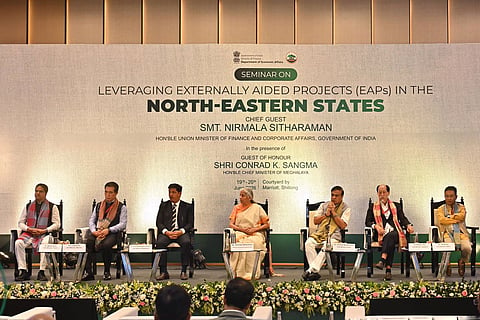
Finance Minister Nirmala Sitharaman stated this while inaugurating the Conference on "Leveraging Externally Aided Projects (EAPs) in the North-Eastern States" in Shillong today, while emphasising that the Northeast is entering a decisive phase of development where stronger institutions, implementation capacity and partnerships are as important as investments.
The two-day conference, organised by the Department of Economic Affairs (DEA), Ministry of Finance, brought together policymakers, state governments, multilateral development banks, bilateral agencies and development practitioners to deliberate on strategies for enhancing the effectiveness of externally aided projects and accelerating inclusive and sustainable growth across the Northeast.
The inaugural session was attended by Chief Minister of Assam, Dr Himanta Biswa Sarma; Chief Minister of Meghalaya, Conrad K. Sangma; Chief Minister of Mizoram, Lalduhoma; Chief Minister of Nagaland, Neiphiu Rio; Chief Minister of Sikkim, Prem Singh Tamang; and Chief Minister of Tripura, Dr. Manik Saha, along with senior officials from the Government of India, representatives of the World Bank, Asian Development Bank (ADB), Asian Infrastructure Investment Bank (AIIB), International Fund for Agricultural Development (IFAD), New Development Bank (NDB), Japan International Cooperation Agency (JICA), NITI Aayog and other development institutions.
Sitharaman noted that Externally Aided Projects have emerged as an important source of development financing for the North-Eastern States, supporting investments in infrastructure, connectivity, livelihoods and social-sector development. She said the conference provides a valuable platform for the Centre and the Northeastern states to strengthen planning and implementation of such projects through greater coordination, faster execution and the sharing of best practices.
In her keynote address, the Finance Minister said that the Northeast is entering a decisive phase of development where stronger institutions, implementation capacity and partnerships are as important as investments. She noted that under the leadership of Prime Minister Narendra Modi, the Northeast has moved from the margins to the mainstream of India's development agenda and will be central to the realization of the vision of Viksit Bharat by 2047.
The Finance Minister outlined eight key enablers that will shape the next phase of development in the region.
She emphasised the importance of leadership, noting that alignment between the Centre and the States accelerates development outcomes and strengthens public confidence. She also stressed the need to strengthen institutional capacity for effective planning, implementation, monitoring and service delivery.
Highlighting the Northeast's demographic strengths, Sitharaman described the region's youth, entrepreneurial energy and women leaders as key drivers of growth.
On development finance, the Finance Minister urged states to leverage multilateral and bilateral financing not only as a source of funding but also as a means of accessing global expertise, innovation and best practices. She encouraged states to make strategic use of externally aided projects to strengthen governance systems and improve service delivery.
Union Minister Sitharaman also pointed to the vast opportunities for private investment in sectors such as tourism, logistics, agribusiness, food processing, renewable energy, digital services, manufacturing and the orange economy.
She highlighted the transformative impact of ongoing investments in connectivity, noting that improvements in transport infrastructure, digital networks and power systems are linking people, markets and opportunities while reinforcing India's Act East Policy.
Describing the Northeast's rich ecological and cultural heritage as a strategic advantage, she said the region can emerge as a leader in eco-tourism, climate resilience, sustainable agriculture and green development.
On the importance of partnership and cooperation, Sitharaman stressed that lasting progress will require close collaboration among governments, communities, investors, academia, civil society organisations and development institutions.
The conference featured technical sessions on the evolving ecosystem of externally aided projects in India and the Northeast, with presentations by the Department of Economic Affairs, World Bank, Asian Development Bank and NITI Aayog. Participants also shared experiences from the implementation of externally aided projects across Northeastern states and deliberated on ways to improve project preparation, execution and monitoring.
