
- Home
- Live Blog
- Breaking News
- Top Headlines
- Cities
- NE News
- Sentinel Media
- Sports
- Education
- Jobs
Staff Reporter
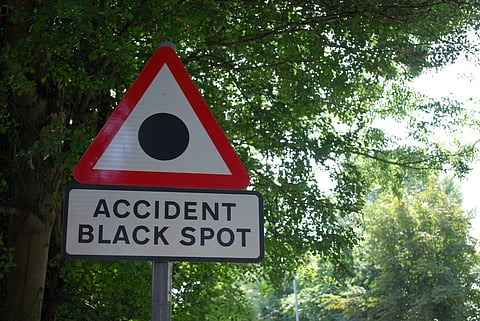
Guwahati: It is worth pondering that there are as many as 486 black spots identified on National Highways in the Northeast, including Assam. Of this total, long-term rectification is yet to be completed on 279 black spots. Assam is home to 285 of these black spots, of which only 77 have undergone long-term rectification.
The Ministry of Road Transport & Highways (MoRTH) identifies certain locations on National Highways (NHs) as black spots based on the occurrence of a certain number of accidents involving fatalities and grievous injuries, depending on the accident reports received from the state governments concerned.
Assam tops the list of NE states in terms of both black spots and fatalities from accidents. In 2025, a total of 6,303 accidents occurred on NHs in Assam, leading to 1,602 fatalities. Incidentally, as many as 1,722 people perished in 3,766 accidents in 2024 in the state. In 2023, 3,427 accidents resulted in a total of 1,564 fatalities.
According to information available with The Sentinel, 285 black spots were identified in Assam, and long-term rectification work was completed in only 77 such spots. This implies that 208 black spots still require long-term rectification. The neighbouring state of Meghalaya had 56 spots identified, of which 23 had long-term rectification, leaving 33 with such measures yet to be completed. Significantly, Mizoram had only 1 black spot, and long-term rectification work was completed on that spot. Similarly, Sikkim had 16 black spots, and long-term rectification work was completed on all of them.
As for the other states in the Northeast, 71 black spots were identified in Nagaland, and long-term rectification work was done in 64 spots; Manipur had 19 black spots, and long-term rectification was completed in 14 such spots; Tripura had 29 black spots, and long-term rectification was done in 12; Arunachal Pradesh had 9 black spots, but long-term rectification has not been done in a single such spot.
According to MoRTH, the government has taken steps for immediate, short-term measures on such black spots as road markings, signage, crash barriers, road studs, delineators, closure of unauthorized median openings, traffic calming measures, etc. Long-term rectification works include improvements to road geometrics, junction enhancements, spot widening of the carriageway, and the construction of underpasses and overpasses; these activities require pre-construction tasks such as land acquisition, forest clearance, and utility shifting, which can take a significant amount of time. Electronic Detailed Accident Report (eDAR) (erstwhile Integrated Road Accident Database or IRAD) has been developed, a central repository for reporting, management and analysis of road accident data across the country. The database enables authorities to identify accident-prone locations through analytics, implement preventive measures, monitor the actions taken, and ensure efficient processing of road accident claims.
With such a large number of black spots yet to see long-term rectification work in Assam and a few other NE states, national highway development agencies have to ensure that proper thrust is given to rectify such spots so that the number of accidents and fatalities goes down. As per records, the NE region witnessed 1,918 fatalities from accidents on NHs in 2025.
Also Read: Meghalaya Cabinet Clears Prison Reforms, Legal Metrology Amendments and Sports Appointment Rules
