
- Home
- Live Blog
- Breaking News
- Top Headlines
- Cities
- NE News
- Sentinel Media
- Sports
- Education
- Jobs
Kumar Bhaskar Varma, the last king of the Varman dynasty, ruled Kamarupa from 594 CE (some say 600 CE) to 650 CE. He is regarded as the most illustrious and influential ruler of Kamarupa. Although he was the king of Kamarupa, Kumar Bhaskar Varma possessed a vision that extended beyond regional boundaries, reflecting an all-India as well as international outlook. During the reign of Kumar Bhaskar Varma, the famous Chinese traveller Hiuen Tsang visited Assam-then known as ancient Kamarupa-between 640 and 643 CE, honouring the king's invitation. In his travel accounts, he recorded several important observations about Kamarupa. He wrote about the fertility of the land and its suitability for agriculture, noting that the people were deeply engaged in farming. He described the irrigation systems of ancient Kamarupa, including the practice of drawing canals from rivers or embankments to supply water around towns. He also mentioned the region's temperate climate, the simplicity of its people, their keen interest in learning and their strong memory and intellectual abilities. Hiuen Tsang further recorded the religious practices of the people and noted that scholars travelled from distant places to Kamarupa in pursuit of knowledge. Through his travel accounts, the wider world came to know many of these significant details about ancient Kamarupa. In this sense, King Kumar Bhaskar Varma may be regarded as the visionary leader who first introduced Assam to the wider world. The travel accounts of Hiuen Tsang describe him as a learned and enlightened ruler, deeply respected by his subjects. His observations remain among the earliest and most reliable written records of ancient Assam.
Kumar Bhaskar Varma's influence in North India
With his broad all-India and global outlook, Kumar Bhaskar Varma forged close diplomatic and military ties with the great northern Indian Emperor Harshavardhana, whose reign marks a significant chapter in Indian history. The two rulers maintained warm diplomatic relations and treated one another with mutual respect and importance. Kumar Bhaskar Varma expanded the boundaries of Kamarupa westward into North Bengal after defeating Shashanka, the ruler of Gaur who had earlier assassinated Harshavardhana's brother Rajyavardhana. According to the travel accounts of Hiuen Tsang, southeastern Bengal, Sylhet and Tripura also formed part of Kamarupa during Kumar Bhaskar Varma's reign. He further wrote that the sea routes to China were under the supervision of the King of Kamarupa. During Kumar Bhaskar Varma's rule, Assam's prestige spread across India, making this era widely regarded as the golden age of Assamese history. The Assamese calendar, known as Bhaskarabda, is traditionally calculated from his accession to the throne. Today we are officially using this calendar. He is also remembered as "Kumar Raja", as he remained unmarried throughout his life.
At the grand Dharma Sabha held at Kannauj in honour of Hiuen Tsang, Emperor Harshavardhana accorded exceptional respect to Kumar Bhaskar Varma by offering him the place of highest honour. The event was further marked by a magnificent religious procession, in which Harshavardhana, dressed as Lord Indra, and Kumar Bhaskar Varma, dressed as Lord Brahma, walked side by side at the forefront, while all others followed behind. This included eighteen subordinate kings under Harshavardhana, forty princes, nearly three thousand Buddhist scholars and an equal number of Brahmins who had gathered for the occasion. The honour accorded to Kumar Bhaskar Varma at this imperial gathering makes it clear that the King of Kamarupa occupied a uniquely distinguished position in the political and cultural landscape of the time, reflecting the immense influence and prestige he commanded across the subcontinent.
The copperplate inscriptions issued by Kumar Bhaskar Varma prove that ancient Kamarupa had a well-organised, robust and accountable system of governance. His kingdom maintained a formidable naval force, comprising nearly 30,000 boats, along with a powerful army supported by around 20,000 elephants. As a responsible ruler, he took the security of Kamarupa seriously and did not compromise on this.
The Glory of Kamarupa during the Reign of Kumar Bhaskar Varma
The economic condition of ancient Kamarupa reached a remarkable level of prosperity during the reign of Kumar Bhaskar Varma. There were various industries in Kamarupa for the production of bamboo and cane products, paat and muga textiles, perfumes from agar, jaggery prepared from sugarcane and the manufacture of metal utensils and exquisite gold ornaments. This prosperity is evident from the list of gifts sent by Kumar Bhaskar Varma to Emperor Harshavardhana through his envoy Hamsavega. Among the offerings were a remarkable ceremonial umbrella known as the Abhaga, bamboo and cane carpets, agarwood perfumes preserved in silk pouches, a variety of utensils, liquid jaggery stored in earthen pots and paat-muga textiles. The list of gifts also included sanchipaat manuscripts and paintings. This shows that Kamarupa was also a vibrant centre of literature, art and intellectual activity.
In the political history of Assam, the resistance of external aggression led by Kumar Bhaskar Varma will always be remembered with pride by the people of Assam. This seventh-century king, who displayed unparalleled knowledge, military strength and rare strategic skill in warfare and alliances, continues to inspire us today with his courage and spirit of resistance. Kumar Bhaskar Varma's irresistible struggle is a source of inspiration for us in waging a courageous resistance struggle at a time when the indigenous people of Assam are living day and night in fear of losing their language, culture and land due to continuous religious aggression by outsiders.
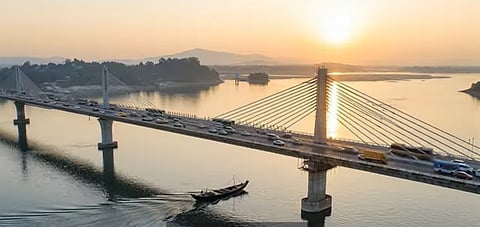
The state government has already established a state university in Nalbari in the name of this great King of Kamarupa. This year the state government has dedicated the newly constructed Guwahati-North Guwahati bridge over the Brahmaputra in the name of Kumar Bhaskar Varma. The bridge will be named Kumar Bhaskar Varma Setu.
Context of Bridge Construction
In 2016, for the first time in Assam, a BJP-led NDA government was formed, and I was entrusted with the responsibility of serving as the Minister of the Guwahati Development Department. I invited the Singapore-based government enterprise Surbana Jurong to Guwahati and assigned it the task of preparing architectural designs for two proposed bridges over the Brahmaputra. These bridges were planned to connect Palashbari-Sualkuchi and Guwahati-North Guwahati. After Surbana Jurong confirmed the feasibility of the projects and prepared the designs, we began discussions and consultations on how to arrange the required funding. At that time, I was also holding the charge of Finance Minister of the Government of Assam. Through Ministry of Finance, we approached the New Development Bank (NDB), popularly known as the BRICS Development Bank, an international financial institution established by Brazil, Russia, India, China and South Africa. The Bank agreed to provide funding for the Guwahati-North Guwahati bridge. This was first ever NDB assisted project in North East and Assam.
As per the agreed terms, the Bank financed 80 percent of the project cost, while the State Government contributed 20 percent. The loan component extended by the Bank to the State Government is to be repaid by the Government of India. In total, the bridge was constructed at a cost of approximately Rs. 3,000 crore, of which around Rs. 2,000 crore was borne by the Government of India and about Rs. 1,000 crore by the Government of Assam.
The bridge connects South and North Guwahati through the heart of the city, fulfilling a long-standing demand of residents on both banks of the river. It significantly reduces travel time and eases traffic congestion in Guwahati, especially as the Saraighat Bridge had long remained the only land route linking the two sides. This new bridge also opens up the possibility of developing twin metropolitan hubs on the lines of Hyderabad-Secunderabad and Ahmedabad-Gandhinagar. With Guwahati facing mounting pressure from rapid population growth and a steadily declining carrying capacity, urban expansion has become inevitable. The new bridge will also help meet that need.
Technical Specifications
There are several new aspects to this bridge. It is about 33 metres wide and has six lanes. Apart from vehicular traffic, the bridge also includes a dedicated sidewalk for pedestrians. Taken together, the old and new Saraighat Bridge have only five lanes, whereas this bridge alone has six - an important point to note. The bridge uses extradosed technology, enabling a 200-metre span that reduces the number of pillars in the middle of the Brahmaputra River. The cables attached to the structure further enhance its load-bearing capacity. The main bridge is 1.2 km long. Notably, this is the only extradosed bridge in the country to incorporate friction pendulum bearings for earthquake protection. Most importantly, the bridge has been constructed by the Public Works Department of Government of Assam, which is a matter of great pride for us. Earlier, some bridges over the Brahmaputra were built by the Indian Railways, while others were executed by the National Highways Authority of India. For the first time, Assamese engineers, officers, employees and workers have together delivered such a world-class bridge. The Public Works Department of Government of Assam is also constructing the 3.6 km four-lane extradosed bridge connecting Palashbari and Sualkuchi. Previously, this was unimaginable. This is the result of the confidence of a new and resurgent Assam.
Arrival of the Prime Minister
The foundation stone of the bridge was laid on 9 February 2019 by the country's illustrious Prime Minister, Shri Narendra Modi. He will formally inaugurate the bridge on 14 February 2026. Following its official opening, the bridge will remain accessible exclusively to pedestrians until 28 February. Visitors will be able to enjoy panoramic views of Kamakhya Temple and the Nilachal Hills, along with the scenic beauty of Guwahati and the majestic Brahmaputra River. Vehicular movement across the bridge will commence at a later date. On the same day as the inauguration, the Prime Minister will also lay the foundation stone of the Indian Institute of Management Guwahati, marking another significant milestone in the region's development.
Progressive Assam
This is undoubtedly a golden era for Assam. On behalf of the people of the state, I express my sincere thanks and gratitude to the Hon'ble Prime Minister, for his unwavering commitment to the rapid development of Assam and the North East. His genuine affection for the region and deep sense of responsibility towards its progress have ushered in a new phase of growth and transformation. I warmly welcome him to Assam. The new modern, world-class terminal at Lokpriya Gopinath Bardoloi International Airport in Guwahati, already inaugurated by Prime Minister Narendra Modi, will become operational from 22 February. The Assam we see today is unlocking far greater potential, strengthened by the Prime Minister's sincere commitment and affection for the region. In a few days, there will be a Ring Road in Guwahati. Beyond this, four more bridges are planned over the Brahmaputra, including the Narengi-Kuruwa and Palashbari-Sualkuchi bridges. Moving further ahead, there is the Semiconductor project in Jagiroad and, then again, a bit further a 34-km elevated corridor in Kaziranga. Then there is the two-lane tunnel between Numaligarh and Gohpur under the Brahmaputra with provision for both rail and vehicular traffic. Added to this are the expansion of the Numaligarh Oil Refinery and the revival of the Namrup Fertilizer Plant with its fourth unit, each representing milestones in Assam's modern development journey. Together, these initiatives define the identity of a new Assam - steadfast (Atal), unwavering (Avichal) and forward-looking (Agragami). We must sustain this unstoppable momentum that we have built collectively and continue to carry Assam forward with the same global vision once demonstrated by great leaders like Kumar Bhaskar Varma.
Also Read: Protests and Blockades in Digboi Following Lynching of 26-Year-Old Adivasi Youth
